


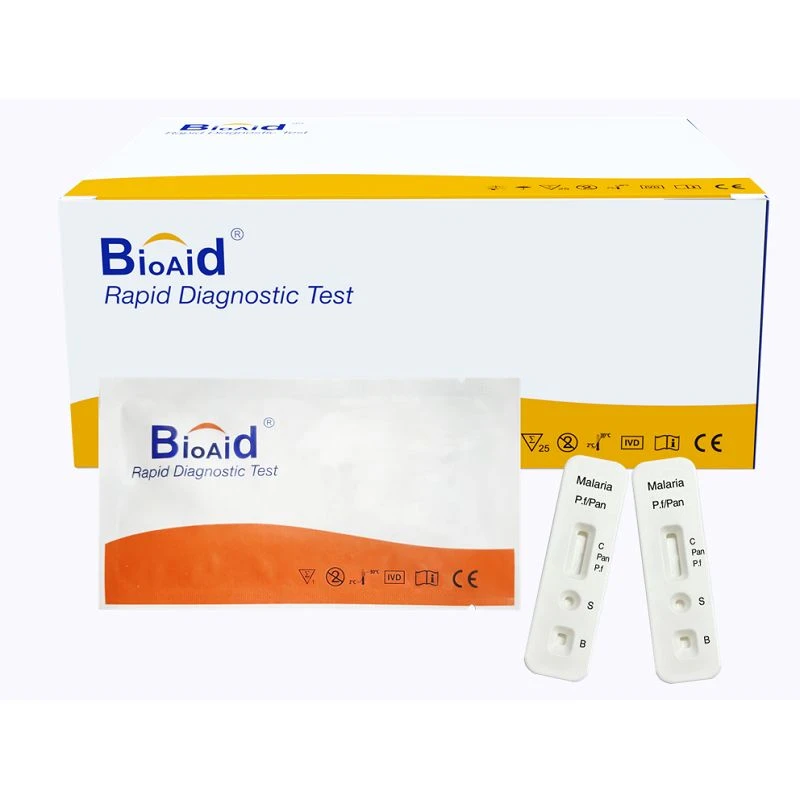
Introduce

The Malaria P.f/Pan Antigen Rapid Test Cassette (Whole Blood) is a rapid chromatographic immunoassay for the qualitative and differential detection of Histidine-Rich Protein II (HRP-II) specific to Plasmodium falciparum (P.f) and Plasmodium lactate dehydrogenase (pLDH) specific to Plasmodium species (Pan) in whole blood.
The Malaria P.f/Pan Antigen Rapid Test Cassette (Whole Blood) is a rapid test to qualitatively detect the presence of Histidine-Rich Protein II (HRP-II) specific to Plasmodium falciparum (P.f) and Plasmodium lactate dehydrogenase (pLDH) specific to Plasmodium species (Pan). The test utilizescolloid gold conjugate to selectively detect P.f-specific and Plasmodium species specific antigens in whole blood.
The Malaria P.f/Pan Antigen Rapid Test Cassette (Whole Blood) is a qualitative, membrane based immunoassay for the detection of P.f, P.v, P.o and P.m antigens in whole blood. The membrane is pre-coated with anti-HRP-ll antibody and anti-PLDH-Pan antibody.During testing,the whole blood specimen reacts with the gold conjugate,which has been pre-coated on the test strip. The mixture then migrates upward on the membrane by capillary action, reacting with anti-HRP-ll antibody on the membrane of P.f Test Line region and with anti-pLDH-Pan antibody on the membrane of Pan Test Line region. If the specimen contains HRP-ll or pLDH-Pan antigen or both,a colored line will appear in P.f line region or Pan line region or two colored lines will both appear in P.f line region and Pan line region. The absence of the colored lines in P.f line region or Pan line region indicates that the specimen does not contain HRP-ll and/or pLDH-Pan antigen. To serve as a procedurpcontrol, a colored line willalways appear in the control line region indicating that proper volume of specimen has been added and membrane wicking has occurred.
Specification
|
Read time |
15-30min |
|
Shelf life |
24 months |
|
Store temperature |
2-30℃ |
|
Operation temperature |
12-30℃ |
|
Sensitivity |
P.f. >99.0%, Pan >99.0% |
|
Specificity |
P.f. >99.0%, Pan >99.0% |
|
Accuracy |
P.f. >99.0%, Pan >99.0% |
Why to test
1. What are malaria tests?
Malaria is a serious disease caused by a parasite. Malaria parasites are tiny single-celled life forms. They live and reproduce in the red blood cells of humans. This destroys the red blood cells, which makes you sick.
In most cases, people get malaria when they are bitten by mosquitos that are infected with the parasite. At first, malaria symptoms may be much like the flu. In certain cases, the disease can become life-threatening if it isn't treated quickly. But medicines can usually cure malaria.
Malaria tests look for signs of a malaria infection in a sample of your blood. The tests can diagnose malaria early so the disease can be cured before it causes serious illness. Malaria testing is used if you have symptoms of malaria and you have recently been in parts of the world where malaria is common.
Malaria is mostly found in warm, humid parts of the world. The highest number of cases are in parts of Africa south of the Sahara Desert. Some cases are in people who have traveled in tropical and subtropical areas where mosquitos spread a lot of disease.
In rare cases, malaria is spread through contact with the blood of an infected person. This may happen during blood transfusions, organ transplantations, or sharing needles and other items used to inject drugs. If you're pregnant when you have malaria, it's possible to give it to your unborn baby. But malaria isn't catchy like a cold or flu. And it can't be spread through sex or being near someone who has malaria.
Other names: malaria blood smear, malaria rapid diagnostic test, malaria by PCR
2. What are they used for?
Malaria tests are used to diagnose malaria. There are different types of malaria parasites that infect humans. The tests can tell which type you have. This information is important for choosing the right treatment to cure the disease.
Malaria testing is also used to help control the spread of the disease. That's because mosquitos become infected with malaria parasites when they bite a person who has malaria. Then they spread the disease by biting others. Testing helps you get treatment to get rid of the parasites before more mosquitos get the parasite by biting you.
3. Why do I need a malaria test?
You may need this test if you have symptoms of malaria and you've been in an area where malaria is common. Depending on the type of malaria parasite, symptoms usually begin between 7 to 30 days after an infected mosquito bites you. But symptoms can take up to a year to appear. So, if you have symptoms, remind your health care provider about any places you've traveled over the past 12 months.
The first symptoms of malaria are often like having the flu, and may include:
● Fever
● Chills
● Fatigue
● Headache
● Muscle pain
● Nausea and vomiting
If you are infected with certain types of malaria parasites, you may have symptoms which come and go every two or three days.
Without treatment, malaria can quickly become a life-threatening disease. As it gets worse, the symptoms will depend on the type of parasite you have. They may include:
● Anemia
● Jaundice
● Kidney failure
● Seizures
● Mental confusion
● Coma
Test Method

Catalog
|
Product Name |
Model |
Catalog Number |
Components |
Sample Type |
Strip Type |
|
Malaria P.f/Pan Antigen Rapid test |
FS10-102 |
FS10-11*-1 |
25 test cassettes 1 buffers (2mL) 25 Droppers |
Whole Blood |
Cassette |
Hot Tags: malaria p.f rapid test, China malaria p.f rapid test manufacturers, suppliers, factory, Rdt Test For Malaria, Dengue NS1 Rapid, NS1 Antigen Rapid Test, Influenza A B Rapid Test, Malaria Parasite Rapid Test, H Pylori Rapid


